The LinkedIn Article
Many years ago, I happened to visit the Blind People's Association in Ahmedabad. One sight I will never forget is that of young men and women running their fingers over large and heavy Braille books.
The challenges were obvious. The books were bulky, expensive and available only in limited numbers. A sighted person can carry hundreds of books in a mobile phone. Why couldn't a visually impaired person do the same?
I have spent many years thinking about this question. Yesterday, I finally came up with a simple answer.
The answer is not Braille. It is audio.
Blind users can already listen to text. The real challenge is navigation.
When a sighted reader misses something, the eyes simply jump back a sentence or two. An audio listener is often forced to rewind by time and guess where the required sentence begins.
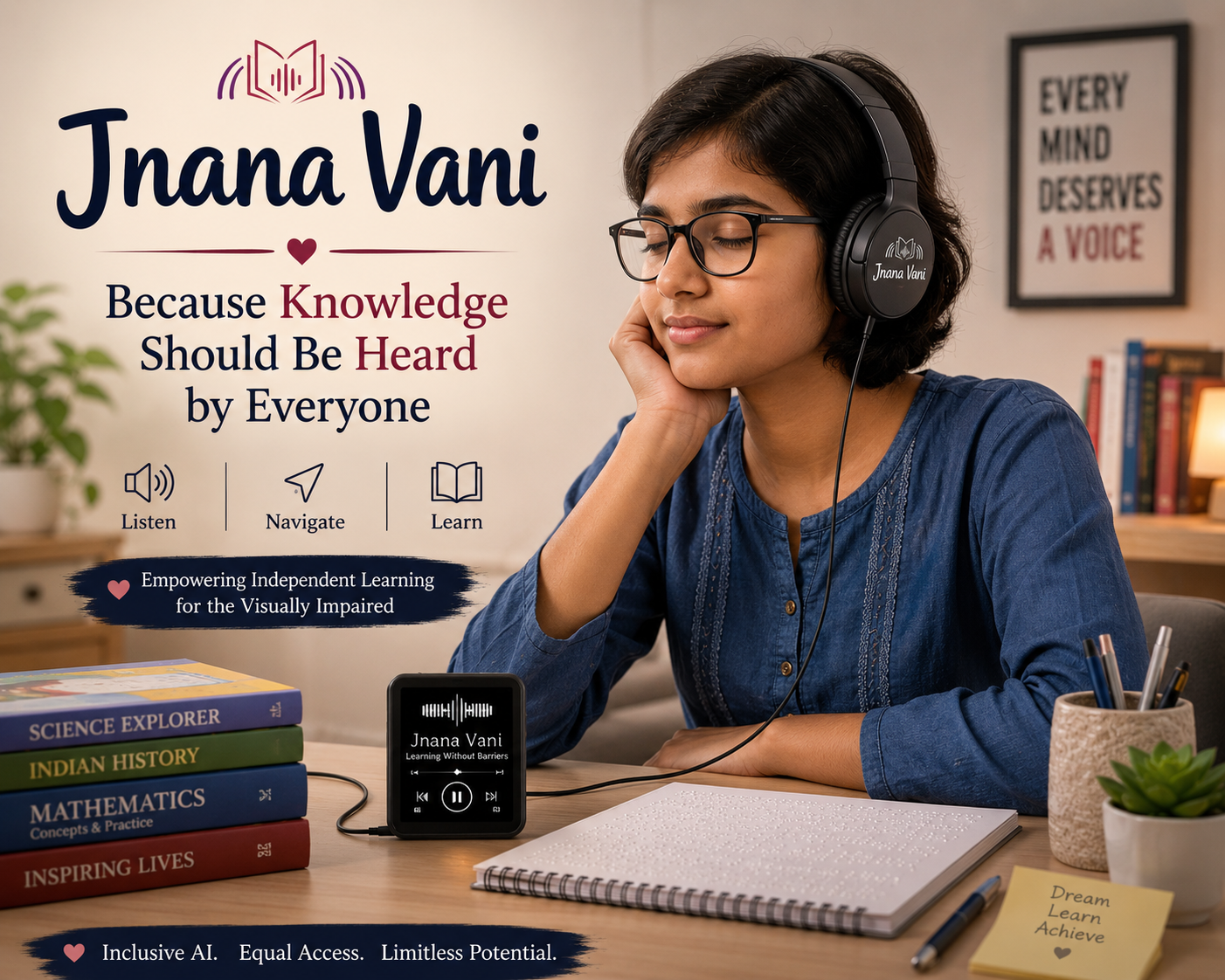
Jnana Vani proposes a different approach.
Instead of navigating speech by seconds, it navigates speech as structured text—through sentences and paragraphs.
The system is extremely simple. It consists of a mobile app and a small handheld controller with five tactile keys:
- Previous Paragraph
- Next Paragraph
- Previous Sentence
- Next Sentence
- Enter
What does this mean?
A visually impaired user can:
- Read any text file. Project Gutenberg alone offers more than 75,000 free books.
- Learn the system in minutes.
- Carry an entire library in a pocket.
- Read independently, anywhere and anytime.
Jnana Vani is still just a proof of concept.
But it represents something larger.
As AI becomes more powerful, we often focus on what is impressive. Perhaps we should spend more time thinking about what is inclusive.
Because knowledge should be heard by everyone.
Wish someone would help me build this.
How to move forward
The app is already written. However, it is written in JavaScript/PhP and works on a web browser. Given the target audience, it would be much better to have it as a Java based app running direcrly on Android/IOS. The conversion is straightforward, but needs to be done.
Again, because what I have created is a "Proof of Concept" rather than a final version, no attempt has been made to optimize the app. As a result, there are long delays while waiting for the text to be converted to speech.
In the final version, I expect interaction with the app to be done by a hand-held system with 5 tactile keys. I am not sure whether these are available in the market, else they would have to be designed.
Interested?
Do Email me! Or WhatsApp me!